

Chauffeur services struggle with outdated booking workflows that create operational bottlenecks, wasted fuel, and frustrated customers. Modern dispatch solutions transform these inefficiencies into competitive advantages through real-time tracking, intelligent matching algorithms, and data-driven route optimization. This guide walks you through preparing your infrastructure, executing an optimized booking workflow, verifying results with measurable metrics, and scaling operations with compliant licensed-fleet models. By implementing these advanced dispatch techniques, you'll reduce idle time, cut costs, and deliver superior service that keeps clients returning.
Table of Contents
- Preparing Your Chauffeur Booking Workflow For Efficient Dispatch
- Executing An Optimized Chauffeur Dispatch And Booking Workflow Step-By-Step
- Verifying Efficiency: Monitoring And Improving Chauffeur Booking Outcomes
- Scaling And Compliance: Integrating Licensed-Fleet Models Into Your Workflow
- Enhance Your Chauffeur Booking Workflow With Taxi Web Design Solutions
Key takeaways
| Point | Details |
|---|---|
| Real-time tracking powers modern dispatch | Advanced platforms use GPS and matching algorithms to connect riders with nearby drivers instantly. |
| Data-driven optimization cuts costs | Fleet analytics reduce idle time by over 50% and improve fuel economy by 18% through smarter routing. |
| Licensed-fleet models enable scale | Proper fleet registration supports regulatory compliance while growing operations to 150,000+ active drivers. |
| Continuous monitoring drives improvement | Tracking trip logs and driver behavior reveals bottlenecks and opportunities for workflow refinement. |
Preparing your chauffeur booking workflow for efficient dispatch
Before optimizing your booking process, you need the right technical foundation. Core components of a ride-hailing platform include mobile apps for riders and drivers, backend servers, and admin dashboards. Each piece plays a specific role in creating seamless booking experiences.
Your rider app handles booking requests, fare estimates, and real-time trip updates. The driver app manages ride offers, navigation, and earnings tracking. Backend servers process matching logic, calculate routes, and store trip data. Your admin dashboard provides oversight for dispatchers monitoring fleet activity and resolving issues.
Choosing the right technology stack determines system performance. Real-time communication technologies like WebSockets are crucial for dynamic dispatch, enabling instant updates between drivers and riders. Map integration through APIs like Google Maps or Mapbox powers accurate ETAs and turn-by-turn directions.
GPS tracking forms the backbone of efficient dispatch. Your system must capture driver locations every few seconds to match riders with the closest available vehicle. Event-driven architecture ensures booking requests trigger immediate responses rather than waiting for scheduled checks. This low-latency approach minimizes wait times and maximizes fleet utilization.
Pro Tip: Build your infrastructure to handle 3x your current peak demand. Sudden spikes from weather events, concerts, or airport rushes will test system limits, and scalable architecture prevents crashes during your busiest revenue periods.
Prepare for growth by selecting cloud platforms that auto-scale resources. AWS, Google Cloud, and Azure offer managed services that expand capacity automatically when booking volume surges. This elasticity protects revenue during high-demand windows while controlling costs during slower periods.
Consider these essential infrastructure components:
- Database systems supporting high-speed reads and writes for trip state updates
- Message queues managing asynchronous tasks like notifications and billing
- CDN distribution ensuring fast app performance across geographic regions
- Monitoring tools tracking system health, response times, and error rates
Your enterprise taxi dispatch software must integrate payment gateways supporting multiple methods. Riders expect options like credit cards, digital wallets, and corporate accounts. Secure tokenization protects sensitive payment data while enabling one-tap checkout.
| Component | Primary Function | Key Technology |
|---|---|---|
| Rider App | Booking requests and trip tracking | React Native or Flutter |
| Driver App | Ride acceptance and navigation | Native iOS/Android |
| Backend Server | Matching and state management | Node.js or Python |
| Admin Dashboard | Fleet oversight and analytics | React or Vue.js |
Establish redundancy for critical systems. Duplicate databases across multiple availability zones so hardware failures don't disrupt bookings. Implement failover mechanisms that automatically reroute traffic when primary servers experience issues. Your booking workflow depends on consistent uptime.
Executing an optimized chauffeur dispatch and booking workflow step-by-step
With infrastructure ready, your platform executes a precise sequence for each booking. Understanding this workflow helps you identify optimization opportunities and troubleshoot issues when they arise.
Step one begins when a passenger opens your app and enters pickup location, destination, and service preferences. Your system instantly calculates fare estimates using zone-based pricing and current demand multipliers. The real-time tracking and dispatch workflow includes trip matching, ETA calculation, and live driver location updates to deliver accurate predictions.
Your matching algorithm evaluates available drivers within a defined radius. It considers proximity, driver ratings, vehicle type, and current heading to select optimal candidates. Advanced systems predict where drivers will be in 60 seconds rather than using static positions, improving match accuracy for moving vehicles.
Systems must deliver ride offers to drivers and capture accept/decline responses efficiently to ensure quick matches. Your platform sends offers to the top three candidates simultaneously, awarding the trip to whoever accepts first. This parallel approach reduces wait times compared to sequential offers.
Once a driver accepts, your system locks the match and notifies the rider with driver details, vehicle information, and live ETA. The driver app displays optimal routing to the pickup location, adjusting dynamically as traffic conditions change. Real-time updates keep both parties informed throughout the journey.

Pro Tip: Implement automatic rematch logic when drivers cancel within two minutes of acceptance. Your system should immediately offer the trip to the next-best candidate without requiring the rider to rebook, preserving the customer experience during driver-side issues.
During the trip, your backend persists state changes at key milestones:
- Driver en route to pickup location
- Driver arrived at pickup, waiting for passenger
- Trip started with passenger onboard
- Trip completed at destination
- Payment processed and receipt generated
Each state transition triggers notifications, updates ETAs, and logs events for billing accuracy. Your fleet management features should display these states in real-time dashboards, giving dispatchers visibility into every active trip.
Continuous location tracking enables dynamic ETAs that adjust based on actual progress. If a driver encounters unexpected delays, your system recalculates arrival times and notifies the rider proactively. This transparency manages expectations and reduces support inquiries.
Your platform must handle edge cases gracefully. When GPS signals drop in tunnels or parking garages, interpolate positions using last-known location and expected route. If a rider cancels mid-trip, calculate partial fares based on distance traveled. Robust error handling prevents system failures from creating billing disputes.
| Workflow Stage | System Action | User Experience |
|---|---|---|
| Booking Request | Calculate fare and match drivers | Instant price estimate |
| Driver Match | Send offers and await acceptance | See nearby drivers |
| En Route | Track driver location and ETA | Live map updates |
| Trip Active | Log route and distance | Real-time progress |
| Completion | Process payment and generate receipt | Automatic billing |
Persisting comprehensive trip logs supports dispute resolution and regulatory compliance. Store pickup/dropoff coordinates, timestamps, route geometry, and fare breakdowns. This audit trail protects your business when riders contest charges or claim service issues.
Verifying efficiency: monitoring and improving chauffeur booking outcomes
Optimizing your workflow requires measuring results and acting on insights. Data-driven fuel management platforms can improve fleet fuel economy by 18% and reduce idle time by over 50%, demonstrating the impact of analytics-driven improvements.
Monitor idle time as your primary efficiency metric. Vehicles sitting between trips waste fuel and reduce revenue potential. Your dashboard should display idle percentages by driver, shift, and zone. Patterns reveal whether dispatch logic needs tuning or if driver supply exceeds demand in specific areas.
Driver behavior significantly impacts fuel consumption. Track acceleration patterns, braking frequency, and speed consistency through telematics integrations. Coaching drivers on smooth acceleration and anticipating stops reduces fuel waste by 10-15%. Gamification features that reward efficient driving create positive competition among your fleet.
Inefficient routing can increase fuel consumption by 8-12%, highlighting the value of route optimization. Your system should balance fastest routes with fuel economy, considering factors like highway versus surface streets. Premium services prioritize speed, while standard bookings can optimize for efficiency.
Implement real-time alerts for operational anomalies. When average trip times exceed baselines by 20%, investigate whether traffic, construction, or system issues are causing delays. Proactive monitoring prevents small problems from becoming service failures.
Pro Tip: Compare actual trip durations against predicted ETAs to calibrate your routing algorithm. If predictions consistently run short, adjust time buffers to improve accuracy and reduce customer complaints about late arrivals.
Persisting trip logs enables deep analysis of service patterns:
- Peak demand hours requiring surge pricing or driver incentives
- Geographic zones with consistent booking volume
- Average trip distances by time of day
- Customer retention rates after service issues
Your fleet efficiency solutions should surface actionable insights automatically. Dashboards highlighting top performers and struggling drivers help you allocate coaching resources effectively. Trend analysis reveals whether workflow changes improve or harm key metrics.
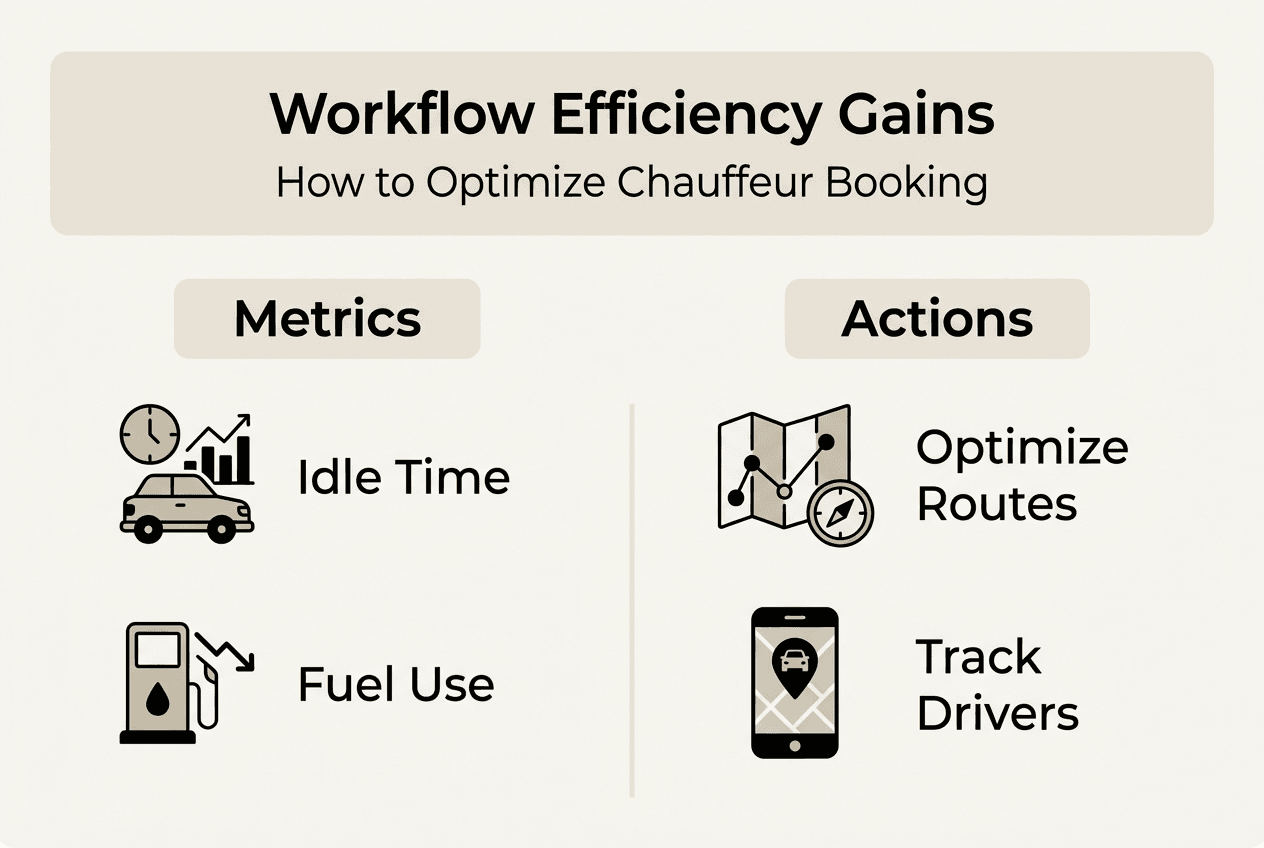
| Efficiency Metric | Target Range | Improvement Action |
|---|---|---|
| Idle Time Percentage | Under 25% | Adjust driver supply or expand service area |
| Average MPG | 15-20% above baseline | Coach inefficient drivers on smooth acceleration |
| ETA Accuracy | Within 3 minutes | Calibrate routing algorithm with actual data |
| Trip Acceptance Rate | Above 85% | Review fare estimates and driver incentives |
Continuous verification cycles create compound improvements. Monthly reviews of efficiency metrics identify trends requiring strategic adjustments. Weekly check-ins address tactical issues like individual driver performance. Daily monitoring catches urgent problems before they impact service quality.
Benchmark your performance against industry standards and your own historical data. If competitors complete trips 15% faster, analyze their routing strategies and driver density. If your fuel economy improved 8% after implementing route optimization, quantify the annual cost savings to justify further technology investments.
Scaling and compliance: integrating licensed-fleet models into your workflow
Growing your chauffeur service requires balancing expansion with regulatory compliance. Integrating licensed-fleet models enables compliance, tax transparency, and scalability, growing platforms to over 150,000 active drivers through structured fleet partnerships.
Licensed-fleet structures let transportation companies operate vehicles under your platform while maintaining separate business entities. Each fleet handles driver recruitment, vehicle maintenance, and insurance, reducing your operational burden. You provide technology and customer acquisition while fleets manage daily logistics.
This model supports regulatory compliance in markets requiring specific licenses or permits. Fleets obtain necessary credentials, ensuring every trip meets local transportation laws. Your platform verifies fleet licensing status before allowing them to accept bookings, protecting your brand from compliance violations.
Drivers benefit from choosing fleets with varied commission structures and support services. Some fleets offer lower commission rates but minimal assistance, appealing to experienced drivers. Others provide vehicle leasing, insurance packages, and 24/7 support at higher commission rates, attracting newer drivers needing comprehensive backing.
Tax transparency improves when fleets handle driver payments and withholdings. Each fleet issues tax documents to their drivers, simplifying your platform's reporting obligations. This separation clarifies contractor relationships and reduces audit complexity as you scale across jurisdictions with different tax requirements.
Your licensed-fleet management system must track performance metrics by fleet. Monitor acceptance rates, cancellation frequencies, and customer ratings to ensure all fleets maintain service standards. Underperforming fleets receive warnings and improvement deadlines before suspension from your platform.
Implement these controls for effective fleet partnerships:
- Onboarding verification of business licenses, insurance certificates, and vehicle registrations
- Real-time monitoring of fleet-level performance against platform standards
- Commission structures supporting different fleet business models
- Automated alerts when fleets approach compliance violations or quality thresholds
Scale operations efficiently by recruiting fleets in new markets rather than building infrastructure from scratch. Local fleet partners understand regional regulations, driver preferences, and customer expectations. This knowledge accelerates market entry and reduces costly compliance mistakes.
Maintain acceptable service standards through tiered fleet partnerships. Premium fleets meeting higher quality benchmarks receive priority in trip assignments and marketing exposure. Standard fleets handle baseline service levels. This competition incentivizes fleets to improve driver training and vehicle quality.
Technology integration ensures seamless fleet operations within your platform. Fleets access dedicated dashboards showing their drivers' activity, earnings, and performance metrics. Your backend tracks which fleet each driver belongs to, routing commission payments correctly and generating fleet-specific analytics.
Enhance your chauffeur booking workflow with Taxi Web Design solutions
Applying these workflow optimization strategies requires robust technology supporting every stage from booking to completion. Taxi Web Design delivers enterprise taxi dispatch software purpose-built for chauffeur services demanding reliability and performance.
Our platform provides real-time GPS tracking, intelligent driver matching, and route optimization that reduces fuel costs while improving service speed. Branded mobile apps for iOS and Android give your business a professional presence that builds customer loyalty. Automated dispatch eliminates manual assignment errors and maximizes fleet utilization during peak periods.
Fleet analytics dashboards surface the efficiency metrics discussed in this guide, from idle time percentages to fuel economy trends. Licensed-fleet management tools let you scale operations while maintaining compliance across multiple jurisdictions. With 99.97% uptime and enterprise-grade infrastructure, your booking workflow runs smoothly even during demand surges. Contact our team to explore how we can tailor a solution matching your specific operational needs and growth objectives.
Frequently asked questions
How can I reduce idle time in my chauffeur fleet operations?
Implement predictive positioning that moves idle drivers toward areas with anticipated demand based on historical booking patterns. Real-time analytics identifying idle hotspots let you rebalance driver supply across zones. Incentive programs encouraging drivers to relocate during slow periods further reduce unproductive time.
What technology stack is best for implementing real-time booking updates?
WebSocket connections provide the low-latency communication essential for instant updates between drivers and riders. Pair this with cloud infrastructure offering auto-scaling and managed databases supporting high-speed writes. Mobile apps built on React Native or Flutter enable cross-platform development while maintaining native performance.
How does a licensed-fleet model benefit my chauffeur service?
Fleet partnerships handle driver recruitment, vehicle maintenance, and regulatory compliance, letting you focus on technology and customer acquisition. This structure accelerates geographic expansion since local fleets understand regional requirements. Tax administration simplifies when fleets manage driver payments and withholdings directly.
What metrics should I track to verify booking workflow improvements?
Monitor idle time percentage, fuel economy, ETA accuracy, and trip acceptance rates as primary efficiency indicators. Track average trip duration against predictions to calibrate routing algorithms. Customer retention rates and driver earnings per hour reveal whether workflow changes improve experiences for both sides of your marketplace.
Can advanced dispatch software handle sudden demand spikes efficiently?
Cloud-based platforms with auto-scaling infrastructure expand capacity automatically when booking volume surges. Message queues prevent system overload by managing tasks asynchronously during peak periods. Building for 3x current peak demand ensures your system remains responsive during unexpected events like weather emergencies or major local happenings.