

Most taxi operators think they need a single booking app. Wrong. A successful taxi app ecosystem in 2026 requires three main applications: rider mobile apps, driver mobile apps, and backend server systems, plus admin dashboards. This integrated architecture transforms how you dispatch rides, manage fleets, and scale operations. Understanding these components and their optimization strategies separates thriving transportation companies from those struggling with inefficiency. This guide reveals how to build and optimize each layer of your taxi app ecosystem for maximum operational efficiency and revenue growth.
Table of Contents
- Understanding The Taxi App Ecosystem: Core Components And Architecture
- How Ai Revolutionizes Taxi Dispatch And Operational Efficiency
- Legal Compliance, Licensed Fleet Integration, And Real-Time Fleet Management
- Real-Time Matching Algorithms And Scalability Challenges In Taxi Apps
- Optimize Your Taxi Operations With Advanced Dispatch And Fleet Management
- Frequently Asked Questions
Key takeaways
| Point | Details |
|---|---|
| Multiple integrated apps required | Taxi ecosystems need rider apps, driver apps, backend servers, and admin dashboards working together. |
| AI boosts efficiency and revenue | AI-powered dispatch systems improve revenue by 10-15% through demand forecasting and optimized routing. |
| Licensed fleet integration ensures compliance | Integrating licensed fleets enables legal operation at scale, managing over 150,000 drivers. |
| Real-time algorithms enable scalability | Geospatial indexing and heuristic optimization power millisecond-latency matching at global scale. |
Understanding the taxi app ecosystem: core components and architecture
Your taxi app ecosystem consists of four critical technical components working in concert. The rider mobile app handles booking requests, payment processing, and trip tracking for passengers on iOS and Android devices. The driver mobile app manages ride acceptance, navigation, earnings tracking, and availability status for your fleet. These front-end applications communicate with your backend server system, which processes all business logic, manages databases, handles authentication, and coordinates real-time data flows. The admin dashboard provides your operations team with oversight tools for monitoring fleet performance, managing drivers, configuring pricing zones, and analyzing business metrics.
Architectural decisions determine your platform's ability to scale efficiently. Building separate services for fleet management, admin panels, and receipt processing improves scalability by distributing computational loads across specialized microservices. This modular approach allows you to update individual components without disrupting the entire system. When one service experiences high demand, you can scale only that specific module rather than duplicating your entire infrastructure.
Consider these essential backend services for your ecosystem:
- Authentication and user management systems
- Real-time location tracking and mapping services
- Payment processing and financial transaction handlers
- Notification services for push alerts and SMS
- Analytics engines for business intelligence
- Rate calculation and dynamic pricing modules
The table below compares core components and their primary functions:
| Component | Primary Function | Key Features |
|---|---|---|
| Rider App | Booking and payment | Trip requests, fare estimates, payment methods, ride history |
| Driver App | Ride acceptance and navigation | Availability toggle, earnings dashboard, GPS navigation, trip logs |
| Backend Server | Business logic processing | Database management, API coordination, authentication, data synchronization |
| Admin Dashboard | Operations management | Fleet monitoring, driver management, analytics, pricing configuration |
Pro Tip: Architect your enterprise taxi dispatch software with microservices from the start to simplify future updates and handle traffic spikes without system-wide slowdowns.
How AI revolutionizes taxi dispatch and operational efficiency
Artificial intelligence transforms taxi dispatch from reactive assignment to predictive optimization. AI-powered systems analyze historical booking patterns, weather conditions, local events, and traffic data to forecast demand hotspots before requests arrive. This predictive capability positions your drivers in high-demand areas, reducing wait times and increasing completed rides per shift.
AI capabilities that directly impact your bottom line include:
- Demand forecasting that predicts booking surges 30-60 minutes ahead
- Smart dispatch algorithms matching riders with optimal drivers in seconds
- Dynamic pricing that adjusts fares based on real-time supply and demand
- Route optimization that calculates fastest paths accounting for current traffic
- Driver performance analytics identifying training opportunities
The financial impact proves substantial. AI-powered dispatch systems increase revenue by 10-15% through better vehicle utilization and surge pricing optimization. Your riders benefit too, with wait times reduced by 15-20% compared to traditional dispatch methods. Faster pickups translate directly to higher customer satisfaction scores and repeat bookings.
Machine learning models continuously improve by analyzing completed trips. Your system learns which drivers perform best on specific route types, which neighborhoods generate consistent demand at certain times, and how weather patterns affect booking volumes. AI and machine learning optimize ride allocation and driver coordination beyond human dispatcher capabilities, processing thousands of variables simultaneously to make optimal matching decisions.
ETA accuracy represents another critical AI application. Traditional systems estimate arrival times using simple distance calculations. AI models factor in traffic signal patterns, typical congestion for specific times, driver behavior patterns, and even parking availability at destinations. This precision builds customer trust and reduces support inquiries about driver locations.
Pro Tip: Train your AI models on local traffic and demand data specific to your operating regions. Generic algorithms miss nuances that AI enhanced fleet management tools capture through continuous learning from your actual trip data.
Legal compliance, licensed fleet integration, and real-time fleet management
Regulatory compliance determines whether you operate legally or face shutdowns and fines. Most jurisdictions require taxi services to maintain proper licensing, insurance, and driver certifications. Integrating licensed fleets enables legal operation while scaling to manage over 150,000 drivers across multiple markets. This integration separates legitimate transportation companies from unlicensed ride-sharing operations facing regulatory crackdowns.
Follow these steps to integrate licensed taxi fleets into your platform:
- Verify driver licenses, vehicle registrations, and insurance certificates through automated document scanning
- Configure fleet hierarchies with company owners, fleet managers, and individual drivers
- Establish commission structures and automated payout schedules for each fleet tier
- Implement real-time compliance monitoring for license expirations and inspection deadlines
- Create separate admin access levels for fleet managers to oversee their driver networks
- Generate automated receipts and tax documents for regulatory reporting requirements
Fleet management systems require real-time statistics dashboards showing active drivers, completed trips, revenue by fleet, and commission calculations. Your fleet managers need instant visibility into their operations without accessing your core business data. This separation maintains competitive confidentiality while providing necessary oversight tools.

Commission transparency prevents disputes and builds trust with fleet operators. Your system should automatically calculate commissions based on completed fares, apply agreed percentages, and generate detailed breakdowns showing gross revenue, platform fees, payment processing costs, and net payouts. Automated receipt generation for every transaction creates audit trails satisfying tax authorities and simplifying accounting for fleet operators.
The table below compares essential fleet management features:
| Feature | Benefit | Implementation Priority |
|---|---|---|
| Real-time driver tracking | Monitor fleet location and availability | Critical |
| Automated commission calculation | Eliminate payout errors and disputes | Critical |
| Compliance document management | Prevent operating with expired licenses | High |
| Fleet performance analytics | Identify top performers and training needs | Medium |
| Multi-tier fleet hierarchies | Scale to multiple fleet operators | High |
Driver choice matters for fleet integration success. Allowing drivers to affiliate with licensed fleet companies while using your platform creates flexibility that attracts professional operators. They maintain their existing business relationships while accessing your technology infrastructure and rider network. This model scales faster than recruiting individual drivers because fleet operators bring entire driver networks to your platform simultaneously.
Your fleet management solutions should automate commission processing and receipt generation to eliminate manual accounting tasks that consume administrative resources and introduce calculation errors.
Real-time matching algorithms and scalability challenges in taxi apps
Real-time dispatch algorithms form the computational heart of your taxi app ecosystem. When a rider requests a trip, your system must identify available drivers within pickup range, calculate optimal matches considering multiple factors, and assign the ride within milliseconds. This speed requirement at scale presents significant technical challenges, especially when managing thousands of simultaneous requests across large metropolitan areas.
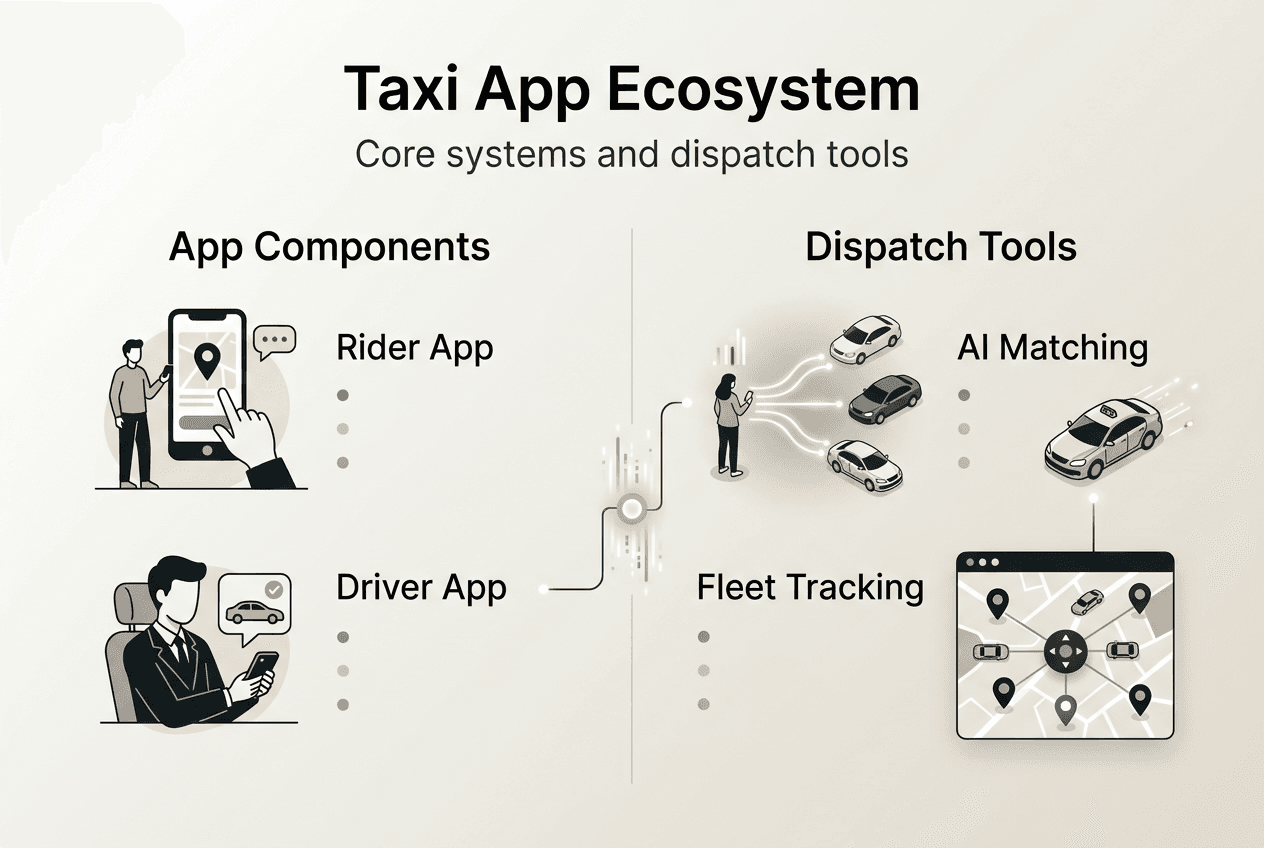
Geospatial indexing solves the fundamental problem of quickly finding nearby drivers. Systems like Google's S2 or Uber's H3 divide geographic areas into hierarchical cells, allowing rapid lookup of drivers within specific regions without scanning your entire driver database. When a booking request arrives, your algorithm queries only the relevant geographic cells, dramatically reducing computation time from seconds to milliseconds.
Optimization techniques for ride-driver matching include heuristics, linear programming, integer programming, and bipartite matching algorithms. Each approach balances speed against matching quality differently. Heuristic methods like nearest-driver assignment execute fastest but may miss better matches that optimize system-wide efficiency. Mathematical optimization techniques find superior matches but require more computation time. Your choice depends on whether you prioritize individual ride speed or overall fleet utilization.
The comparison table shows trade-offs between optimization approaches:
| Algorithm Type | Speed | Match Quality | Best For |
|---|---|---|---|
| Nearest Driver Heuristic | Fastest | Good | Low-density areas, immediate assignment |
| Greedy Assignment | Fast | Better | Medium traffic volumes |
| Linear Programming | Moderate | Optimal | Batch processing multiple requests |
| Bipartite Matching | Slower | Optimal | High-value rides, premium services |
Millisecond latency requirements at global scale make perfect optimization impractical. You cannot evaluate every possible driver-rider combination when handling thousands of requests per second. Instead, successful platforms use multi-stage algorithms that quickly filter candidates using simple heuristics, then apply more sophisticated optimization to a smaller subset of viable matches. This hybrid approach delivers near-optimal results within strict time constraints.
Key technical challenges in dispatch algorithm design include:
- Handling driver cancellations and reassigning rides without degrading user experience
- Balancing driver earnings fairness with rider wait time minimization
- Scaling algorithms across multiple geographic regions with different demand patterns
- Managing edge cases like airport queues and high-demand event locations
- Maintaining performance during traffic spikes from weather events or system outages
Your infrastructure must support horizontal scaling, distributing matching computations across multiple servers as request volumes grow. Database query optimization becomes critical because every millisecond spent retrieving driver locations or rider preferences delays the matching decision. Caching frequently accessed data like driver availability status and location updates reduces database load and improves response times.
Invest in real-time dispatch algorithms that balance speed with match quality, using geospatial indexing and hybrid optimization to handle peak demand without performance degradation.
Optimize your taxi operations with advanced dispatch and fleet management
Building an efficient taxi app ecosystem requires integrating multiple technical components, from AI-powered dispatch to licensed fleet management and real-time matching algorithms. The complexity of coordinating rider apps, driver apps, backend systems, and admin dashboards demands specialized software designed specifically for transportation operations.
Taxi Web Design provides cloud-based dispatch software that addresses every challenge discussed in this guide. Our platform combines automated driver assignment, real-time GPS tracking, zone-based fare configuration, and seamless payment integrations in one comprehensive system. Whether you operate a small fleet or manage thousands of drivers across multiple regions, our enterprise taxi dispatch software scales with your business while maintaining the millisecond response times riders expect. Explore our fleet management solutions to discover how automation, AI-enhanced routing, and compliance tools can transform your taxi operations in 2026.
Frequently asked questions
What is app ecosystem for taxis?
A taxi app ecosystem consists of integrated mobile applications for riders and drivers, backend server systems handling business logic and data processing, and admin dashboards for operations management. These components work together to enable booking, dispatch, payment processing, fleet tracking, and analytics. The ecosystem architecture determines scalability, reliability, and feature capabilities for your transportation service.
How do AI and machine learning improve taxi dispatch efficiency?
AI analyzes historical booking patterns, traffic conditions, and demand signals to predict where ride requests will occur before they happen. Machine learning models optimize driver-rider matching by considering distance, traffic, driver ratings, and vehicle type simultaneously. Dynamic pricing algorithms adjust fares based on real-time supply and demand, maximizing revenue during peak periods. Route optimization reduces trip times by calculating paths that account for current traffic conditions and typical congestion patterns.
Why is integrating licensed taxi fleets important for scalability?
Licensed fleet integration ensures your platform operates legally within local transportation regulations that require proper driver licensing, vehicle inspections, and insurance coverage. This compliance protects your business from regulatory shutdowns and legal liability. Fleet integration allows rapid scaling by onboarding entire driver networks through established fleet operators rather than recruiting individual drivers. Managing commissions, statistics, and compliance documentation through automated systems reduces administrative overhead as you grow.
What are the main technical challenges in real-time taxi dispatch?
Achieving millisecond response times for matching riders with drivers at scale requires sophisticated algorithms and infrastructure. Geospatial indexing systems quickly identify nearby drivers without scanning entire databases. Balancing match quality with speed demands hybrid algorithms that use heuristics for initial filtering and optimization for final assignment. Maintaining performance during traffic spikes, handling driver cancellations gracefully, and scaling across multiple geographic regions present ongoing technical challenges that require careful architecture and continuous optimization.